Construction site PPE checklist.
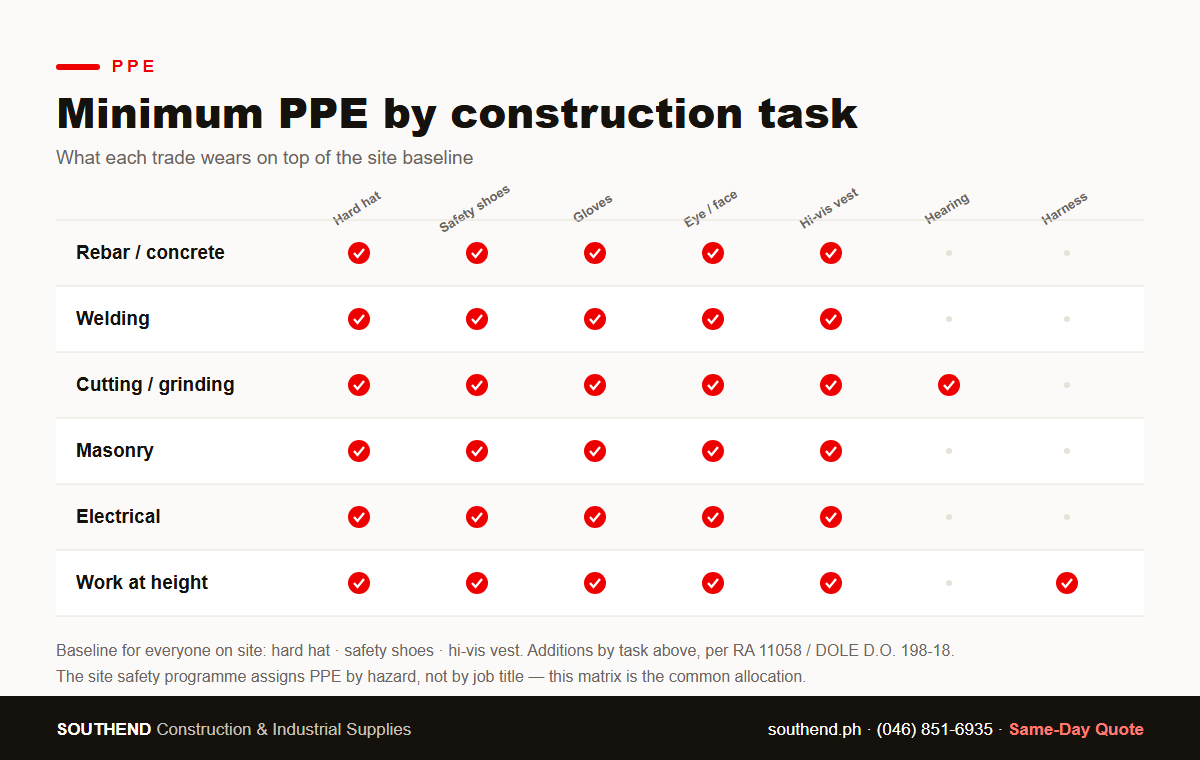
Under RA 11058 and DOLE D.O. 198-18, the employer issues PPE — free of charge, appropriate to the task, replaced when worn. This is the working checklist: the baseline every person on site wears, and what each trade adds on top. The full range is on the PPE page.
The baseline, everyone on site
- Hard hat — ANSI Z89.1 or EN 397 rated.
- Safety shoes — steel or composite toe, ASTM F2413 rated.
- High-visibility vest — anywhere plant, trucks or lifting operate.
Additions by task
| Task | On top of the baseline |
|---|---|
| Masonry / concrete | Work gloves, dust mask, safety glasses; rubber boots on pours |
| Welding | Welding helmet shade 10–13, leather gloves and jacket or apron |
| Grinding / cutting | Face shield over impact goggles (ANSI Z87.1), cut-resistant gloves, ear protection |
| Work at height (≥ 2 m) | Full-body harness, shock-absorbing lanyard, rated anchor point (per the CSHP) |
| Electrical work | Insulated gloves rated for the voltage, insulated tools; no exposed metal jewelry |
| Rebar / steel handling | Heavy leather-palm gloves, long sleeves |
| Noise above 85 dB(A) | Earplugs or earmuffs |
| Dust, silica, fumes | N95 or better, fit to the wearer; respirators for enclosed work |
The site safety and health program required by D.O. 198-18 is the controlling document — it assigns PPE per hazard, not per job title. This table is the common allocation.
Standards and replacement
- Hard hat shells retire around 5 years from the molded manufacture date — sooner in constant sun. Replace after any significant impact.
- Harnesses are inspected before each use and retired immediately after arresting a fall.
- Eye protection is ANSI Z87.1 impact-rated — ordinary eyeglasses are not.
- Respirator filters and disposable masks are replaced per exposure, not per payday.
What the law says
RA 11058 (the OSH law) and its implementing rules, DOLE D.O. 198-18, make PPE an employer obligation: provided at no cost to workers, matched to the hazard, and backed by a site safety and health program with a designated safety officer. DOLE inspects against this. Send the headcount and size breakdown and we quote the full issue the same day.
Common questions
Who pays for PPE on a construction site?
The employer. RA 11058 and DOLE D.O. 198-18 require employers to provide appropriate PPE at no cost to workers — the cost cannot be passed on through salary deductions.
At what height is a safety harness required?
Fall protection is required for work at height — commonly from about 2 m of fall exposure — using a full-body harness with a shock-absorbing lanyard anchored overhead. The specific rule comes from the project's Construction Safety and Health Program (CSHP) under D.O. 13 s. 1998, not a single fixed height.
How long does a hard hat last?
Follow the manufacturer's date: shells are typically retired around 5 years from manufacture, suspensions sooner. Replace immediately after any significant impact, even with no visible damage.
What lens shade for welding?
Shade 10–13 for SMAW and MIG depending on amperage — darker as current rises. Cutting and grinding use impact-rated goggles or a face shield instead, not the welding filter.
Can Southend supply PPE for a whole site?
Yes — hard hats, safety shoes, vests, gloves, eye and ear protection, harnesses and respirators in bulk. Send the headcount and size breakdown and we quote it the same day.
Related
Standards referenced. Standards: RA 11058 & DOLE D.O. 198-18 (general OSH) and D.O. 13 s. 1998 (Construction Safety). PPE allocation follows the site Construction Safety and Health Program (CSHP); this page is a general reference, not a substitute for it.