Choosing a circuit breaker.
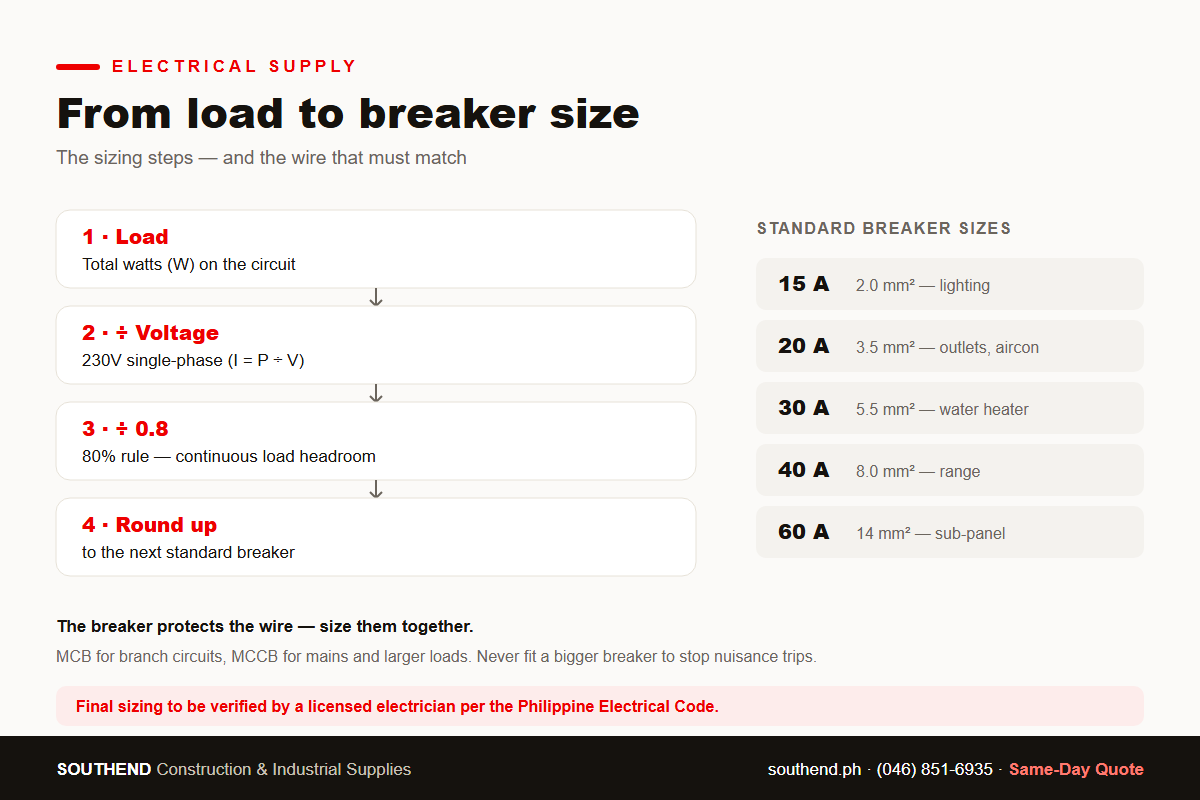
A breaker protects the wire, not the appliance — so breaker and wire size are chosen together, per the Philippine Electrical Code. The table below is the common pairing on 230V residential work. Panel schedules and final sizing are the licensed electrician's job; this page is for reading them and ordering right.
Breaker and wire go together
Illustrative pairings only — NOT a PEC ampacity calculation (which depends on insulation rating, ambient temperature and conduit fill). For reference and ordering.
| Circuit | Wire (THHN copper) | Breaker |
|---|---|---|
| Lighting | 2.0 mm² | 15 A |
| Convenience outlets | 3.5 mm² | 20 A |
| Window aircon, dedicated | 3.5 mm² | 20 A |
| Split-type aircon / water heater | 5.5 mm² | 30 A |
| Electric range | 8.0 mm² | 40 A |
| Small feeder / sub-panel | 14 mm² | 60 A |
Typical pairings only — run length, conduit fill, ambient temperature and actual load all adjust the numbers. The panel schedule from a licensed electrician or electrical engineer governs.
Plug-in or bolt-on
The two mounting types are not interchangeable — match the panel. Plug-in breakers snap onto the bus bar and are the common residential type. Bolt-on breakers screw to the bus for a firmer, vibration-proof connection and are the usual requirement on commercial projects and inspected installations. Both are stocked, single- to three-pole.
Reading the rating
- AT (ampere trip) — the current where the breaker trips. This is the number the circuit is designed around.
- AF (ampere frame) — the frame's maximum rating; a 50AF frame can carry trip units up to 50A.
- Poles — 1-pole and 2-pole for residential 230V branch circuits per the panel design; 3-pole for three-phase.
- kAIC — interrupting capacity. Higher fault levels (near the transformer, commercial service) need higher kAIC breakers.
Ground-fault protection
Bathrooms, kitchen counters, laundry areas, garages and outdoor outlets need ground-fault protection — a GFCI outlet on the branch or an RCBO in the panel. It trips on milliamperes of leakage to protect people, which an ordinary thermal-magnetic breaker never sees.
Common questions
What breaker size for an aircon?
Air-conditioners are sized from the unit nameplate (MCA / MOCP), not a fixed category. A window-type around 1HP commonly runs on a dedicated 20A / 3.5mm² circuit, but always confirm against the nameplate — the dedicated circuit, breaker and wire are sized together per the Philippine Electrical Code.
My breaker keeps tripping — can I put a bigger one?
No. The breaker is sized to protect the wire, not to keep the load running. A bigger breaker on the same wire lets the wire overheat before the breaker trips — that is how electrical fires start. Find the cause: overload, loose termination or a fault.
What does 20AT/50AF mean?
AT is the ampere trip — the current where it trips (20A). AF is the ampere frame — the physical frame's maximum rating (50A). Panel schedules list both; match AT to the circuit and AF to the panel provision.
Plug-in or bolt-on breaker?
Whichever your panel takes — they are not interchangeable. Plug-in breakers snap onto the bus and are common in residential panels; bolt-on breakers screw to the bus for a firmer connection and are the usual requirement on commercial and inspected work.
Where is ground-fault protection required?
Wet and grounded locations: bathrooms, kitchen counters, laundry, garages and outdoor outlets. Use a GFCI outlet or an RCBO in the panel per the Philippine Electrical Code.
Related
Standards referenced. Standards: Philippine Electrical Code (PEC) 2017. The breaker and wire pairings here are illustrative only, not a PEC ampacity calculation — actual conductor and breaker sizing depends on insulation temperature rating, ambient and conduit fill, and must be done by a licensed electrician or professional electrical engineer.
Reviewed July 2026 · Southend Construction & Industrial Supplies, Dasmariñas, Cavite