Which anchor bolt for the job.
The short version: cast-in L or J bolts for column base plates and equipment pads on new concrete; wedge or sleeve anchors for fixing to concrete that is already cured; chemical anchors for heavy loads, close edges or rebar dowels. The tables below are common Philippine practice — where a structural design exists, the design governs. Ordering details and fabrication ranges are on the anchor bolt page.
Types and where each is used
Cast-in anchors go in before the pour; post-installed anchors go into cured concrete.
| Type | How it holds | Typical use | Notes |
|---|---|---|---|
| L-type (bent) cast-in | Bent leg bears on the concrete | Column base plates, light steel frames, equipment pads, gate and fence posts | The common default in the Philippines. Leg commonly 3 to 4 × diameter; set with a template before the pour |
| J-type (hooked) cast-in | Curved hook bears on the concrete | Same duty as the L-type — base plates, light steel, equipment | Same steel and sizes as the L-type; the drawing decides which hook |
| Straight cast-in with nut and plate | Nut and plate washer at the embedded end bear on the concrete | Main building columns, tanks, machine foundations, towers | Highest pull-out of the cast-in types; used where the design specifies F1554 or high-strength anchors |
| Wedge / sleeve expansion (post-installed) | Expands against the wall of a drilled hole | Racks, handrails, machine bases, sign posts fixed to cured concrete | Wedge for solid concrete; sleeve for lighter duty, and CHB or brick with care. Follow the anchor maker's data for cracked concrete and seismic use |
| Chemical (post-installed rod and resin) | Epoxy or vinylester resin bonds the rod to the concrete | Heavy loads, anchors close to an edge, rebar dowels, retrofit and repair | Needs a clean, dry, brushed hole and curing time; capacity comes from the resin data |
Structural connection bolts (ASTM A325, A490) are not anchors — they join steel to steel and appear on an anchor list only for bolting the column to its base plate.
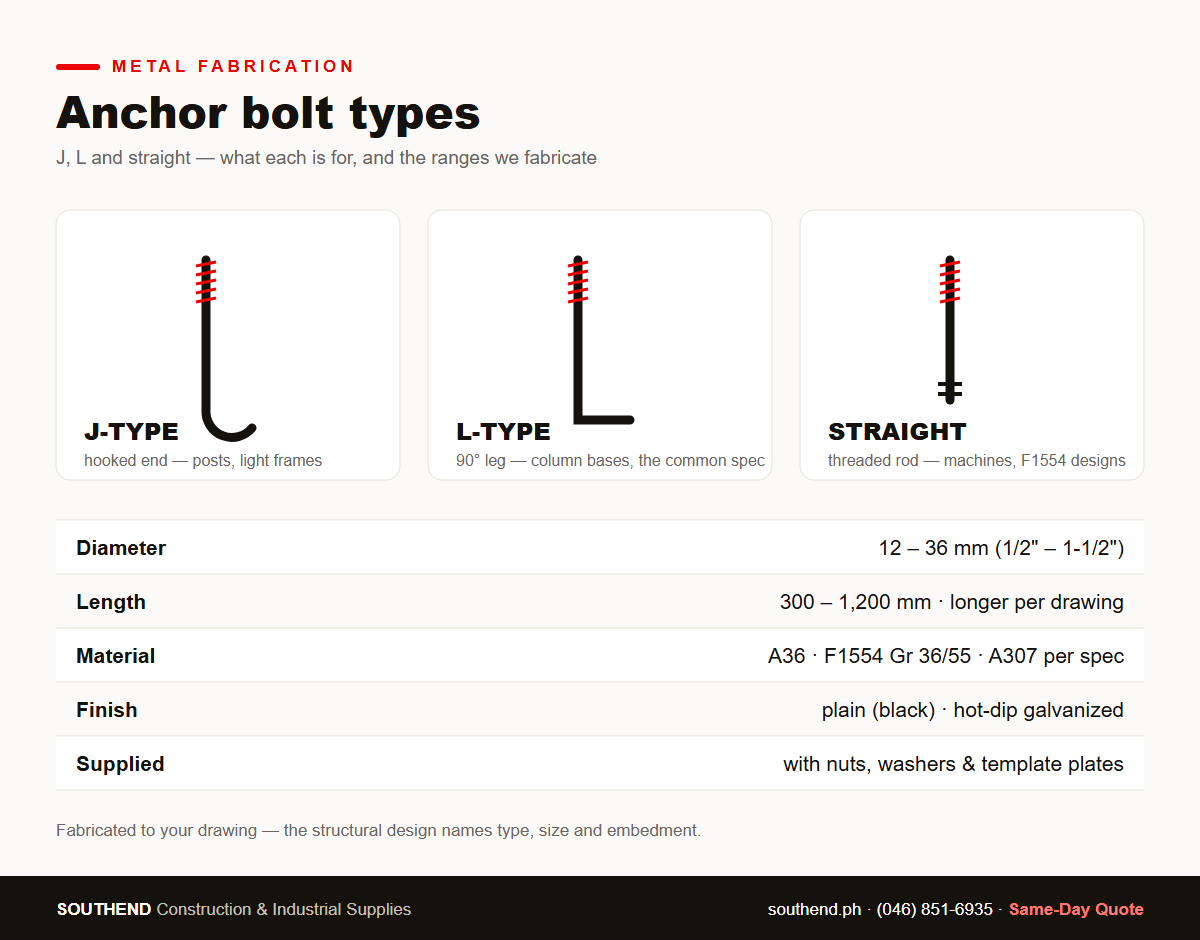
Common sizes: M12 to M36
Metric coarse thread · common cast-in lengths seen on Philippine drawings · for reference only
| Size | Nearest inch size | Thread pitch | Common cast-in lengths | Typical use |
|---|---|---|---|---|
| M12 | 1/2" | 1.75 mm | 150–250 mm | Posts, light frames, sign and fence posts, small equipment |
| M16 | 5/8" | 2.0 mm | 250–400 mm | Light steel columns, roof-frame base plates, gates, machine bases |
| M20 | 3/4" | 2.5 mm | 300–500 mm | Warehouse and shed columns, heavier equipment |
| M24 | 1" | 3.0 mm | 400–600 mm | Main building columns, tanks, crane runway posts |
| M30 | 1-1/4" | 3.5 mm | 500–750 mm | Heavy structural columns, machine foundations |
| M36 | 1-1/2" | 4.0 mm | 600–900 mm | Heavy industrial columns, equipment foundations, towers |
Inch sizes are the nearest common equivalent, not exact conversions (M12 is 12 mm; 1/2" is 12.7 mm) — inch-series anchors are fabricated too. Total length = embedded length + projection above the concrete (base plate, grout, washer, nut and a few threads showing). Embedment is commonly 12 to 20 × diameter for hooked and headed cast-in anchors; the drawing states the exact figure, the bolt pattern and the thread length.
Post-installed sizes: expansion and chemical
Typical figures · the anchor or resin maker's data sheet governs
| Anchor | Sizes | Drill bit | Typical minimum embedment | Use |
|---|---|---|---|---|
| Wedge anchor | M8–M24 (5/16"–1") | Same as the anchor diameter | About 4 to 5 × diameter (M12 ≈ 55–60 mm, M16 ≈ 70–80 mm, M20 ≈ 95–100 mm) | Solid concrete: racks, handrails, machine bases, sign posts |
| Sleeve anchor | M6–M20 | Same as the anchor diameter | About 3 to 4 × diameter | Lighter duty; CHB and brick with care |
| Chemical anchor (threaded rod + resin) | M8–M30 | 2 to 4 mm over the rod (M12 → 14 mm, M16 → 18 mm, M20 → 22–24 mm, M24 → 26–28 mm) | About 8 to 12 × diameter (M16 ≈ 125–190 mm) | Heavy loads, close to edges, rebar dowels, retrofit |
Edge distance and anchor spacing matter as much as embedment on post-installed anchors — too close to an edge and the concrete breaks out before the anchor does. Use the maker's tables or the design.
Grades: A307, A36, F1554, Grade 5, 8.8, stainless
Minimum tensile strength per the standard · design values come from the drawing
| Grade | Standard | Min. tensile strength | Where it is used |
|---|---|---|---|
| A307 Grade A | ASTM A307 | 414 MPa (60 ksi) | The default for L, J and straight cast-in anchor bolts |
| A36 round bar | ASTM A36 | 400–550 MPa | L and J bolts bent from mild steel round bar — same duty as A307 |
| F1554 Grade 36 / 55 / 105 | ASTM F1554 | 400 / 517 / 862 MPa (58 / 75 / 125 ksi) | Engineered anchor rods; Grade 55 with supplement S1 where welding is needed; Grade 105 for heavy loads |
| Grade 5 | SAE J429 | 827 MPa (120 ksi) up to 1"; 731 MPa (105 ksi) over 1" to 1-1/2" | Inch-series high-strength studs and hold-down bolts for equipment |
| Class 8.8 | ISO 898-1 | 800 MPa up to M16; 830 MPa above M16 | Metric high-strength studs, threaded rod and chemical-anchor rod |
| Stainless A2-70 / A4-70 | ISO 3506 (304 / 316) | 700 MPa | Wet, coastal, food and chemical plants; A4 (316) for marine |
A stronger grade does not fix a short embedment or a thin base plate — capacity is set by the concrete, the embedment and the plate as much as by the bolt. Match the grade on the drawing and the nuts and washers to it.
Finishes
- Black (plain) — embedded cast-in bolts in dry interiors; oiled for storage.
- Hot-dip galvanised — ASTM A153 / F2329, zinc about 50 to 85 µm; anything outdoors, wet or in coastal air. Nuts are tapped oversize to clear the zinc, so order nuts with the bolts.
- Electro-galvanised — thin zinc (about 5 to 12 µm), for indoor appearance only, not for weather.
- Stainless 304 / 316 — where rust is not acceptable at all; 316 near the sea.
What to send for a quote
- Diameter and total length, or the embedded length and the projection above concrete
- Type — L, J or straight — and the leg or hook length, or the bolt template or drawing
- Thread length, grade and finish
- Quantity, and whether each bolt comes with nuts and washers (usually two nuts and two washers)
- Site address, so the quote includes the delivery arrangement
Anchor bolts are fabricated to the template in Dasmariñas, Cavite — M12 to M36 and inch sizes, A36 / A307 as standard, F1554 and Grade 8.8 by order, black, hot-dip galvanised or stainless — and delivered nationwide. Send the sizes or the drawing and we quote it back the same day.
Common questions
L-type or J-type anchor bolt — which one?
Both are hooked cast-in anchors doing the same duty, and the drawing usually decides. L-bolts are the common default for base plates in the Philippines; a J-bolt is the same idea with a curved hook. Where pull-out matters, a straight bolt with a nut and plate washer at the embedded end holds more than either hook.
What size anchor bolt for a steel column base plate?
Commonly M16 to M24 on warehouse and shed columns and M20 to M30 on heavier columns — but the size, number and embedment come from the structural design, not from the column size alone. Send the drawing and we fabricate to it.
Cast-in or post-installed anchors?
Cast-in (L, J, straight) when the concrete is still to be poured — they hold best and cost least. Post-installed (wedge, sleeve, chemical) when the concrete is already cured or an anchor was missed. Chemical anchors for heavy loads, close edges or rebar dowels; wedge anchors for general fixing to solid concrete.
A307, Grade 5 or 8.8 — what is the difference?
A307 (and A36 rod) is ordinary mild steel at about 400 MPa tensile — the default for most cast-in anchor bolts. Grade 5 (inch) and Class 8.8 (metric) are heat-treated high-strength steel at about 800 MPa, used where the design calls for high-strength anchors or hold-down bolts. Use the grade on the drawing; a stronger bolt does not make up for a short embedment.
Should anchor bolts be galvanised?
Hot-dip galvanise anything exposed to weather, wet areas or coastal air. Black (plain) is fine for embedded bolts in dry interiors. Galvanised bolts come with nuts tapped oversize to clear the zinc, so order the nuts with the bolts.
What anchor bolts does Southend supply?
L, J and straight cast-in anchor bolts fabricated to your template in M12 to M36 (1/2 to 1-1/2 inch), in A36 / A307 as standard and F1554 or Grade 8.8 by order, black, hot-dip galvanised or stainless, with matched nuts and washers; plus wedge and chemical anchors from the hardware line. Send the sizes or the drawing for a Same-Day Quote.
Related
Standards referenced. ASTM A307, A36, F1554, A153 / F2329 · SAE J429 · ISO 898-1, ISO 3506 · anchoring to concrete per ACI 318 Chapter 17 as adopted in NSCP 2015. This page is for estimating and ordering only, not a design recommendation — anchor size, grade, embedment and spacing are determined by the structural engineer's signed and sealed plan.